

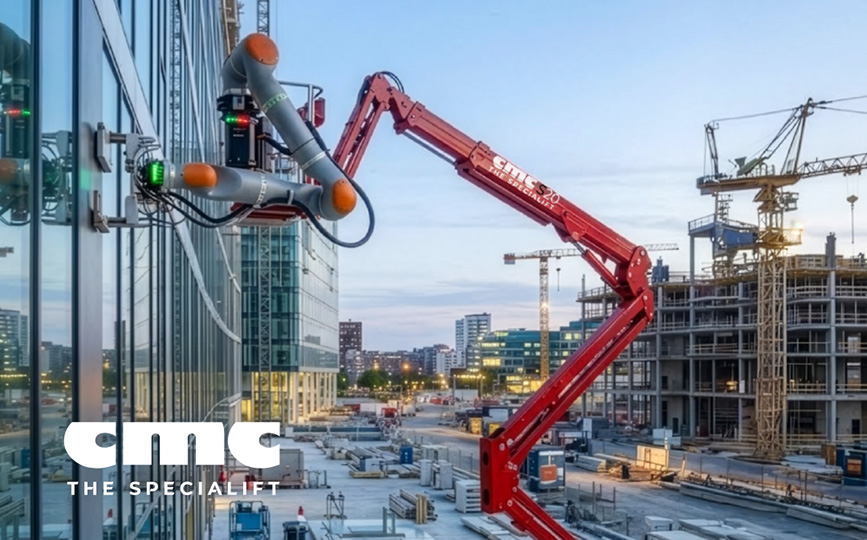
Collaborative robotic integration with aerial platforms in advanced construction sites
The evolution of modern construction sites is characterized by increasing digitalization, the adoption of intelligent systems, and ever closer interaction between operators, machines, and robots. Within this scenario emerges a particularly significant innovation: the integration of collaborative robotics with aerial platforms, especially spider lifts, which thanks to their versatility and precision are ideally suited to host or coordinate robotic systems. The synergy between platforms and cobots does not simply represent the addition of a mechanical arm to the basket, but defines a new paradigm for working at height, where safety, efficiency, and operational quality reach previously unseen levels.
The logic of collaborative robotics in construction sites
Collaborative robotics was created with a clear objective: to allow humans and robots to operate in the same space synergistically, without the safety barriers that characterized traditional robotics. The cobot, equipped with sensors, advanced controls, and adaptive capabilities, does not replace the operator but expands their operational potential. In advanced construction sites, where work at height is frequent and often subject to challenging environmental conditions, the concept of collaboration takes on even greater value.
Aerial platforms thus become a true point of contact between the operator and the robot. Thanks to precise positioning, the ability to reach complex locations, and the capacity to stabilize in difficult conditions, spider lifts are particularly suited to integrating robotic tools capable of performing repetitive, risky, or especially delicate tasks. The combination of human judgment and robotic dexterity opens up new operational possibilities, reducing risks and improving the quality of work.
Applications: from maintenance to advanced inspections
Concrete applications of robotic integration with aerial platforms are numerous and constantly expanding. One of the most widespread concerns structural inspection activities, an area where precision and repeatability are essential elements. With the use of high-definition cameras, laser sensors, and integrated analysis systems, the cobot installed on the basket can carry out close-up inspections of bridges, façades, industrial plants, and complex infrastructures. The operator guides the platform into position while the robot performs repetitive acquisitions with millimetric accuracy.
A second area of great interest is material application, such as sealing, painting, industrial cleaning, or resin application. The cobot can ensure uniform application and consistent movement, reducing waste and increasing final quality. When dealing with large or hard-to-reach surfaces, the spider lift ensures optimal positioning while the robot performs the operation with programmed precision.
Another emerging area involves the assembly and maintenance of components at height, such as electrical installations, photovoltaic systems, or prefabricated structural elements. In these cases, the cobot can assist the operator in supporting, positioning, or manipulating components with moderate weight but requiring high precision, reducing ergonomic risk and increasing process efficiency.
Enabling technologies: sensors, machine vision, and AI
To make robotic integration possible, a set of enabling technologies is required to connect the aerial platform and the collaborative robot. Machine vision plays a central role. Thanks to stereoscopic cameras, LiDAR systems, and depth sensors, the cobot can recognize surfaces, detect obstacles, identify points of interest, and adapt its behavior even in the presence of unforeseen variations.
Artificial intelligence allows robotic systems to learn from data collected during previous operations and to optimize movements. Integration with BIM systems makes it possible to compare the real world with the digital model, improving the precision of on-site operations. At the same time, sensors installed on the spider lift can provide the cobot with real-time information on the machine’s status, including inclinations, vibrations, and operating conditions, ensuring integrated control.
Connectivity is another decisive element. Platforms can communicate with cobots through standardized protocols, enabling synchronization between platform movement and robot operations. This makes it possible to coordinate complex maneuvers in which the platform repositions itself while the robot maintains a stable operational posture.
Operational safety and new interaction protocols
Safety is naturally a central issue. Aerial platforms operate in dynamic contexts and at significant heights, and the addition of collaborative robots requires specific protocols. Cobots are equipped with torque controls that limit applied force in the event of accidental contact, and they can be programmed to stop immediately if unforeseen conditions occur. At the same time, the spider lift must maintain a stable configuration and ensure that robot movement does not generate unwanted oscillations.
The human–machine interface becomes a fundamental element. The operator must be able to control both the platform and the cobot through an intuitive, preferably integrated, command system. Training therefore takes on a new dimension: not only platform operation, but also understanding robotic interaction logic, operational limits, and emergency procedures.
Cobots mounted on the basket or cooperating from the ground: two operational strategies
There are two main integration approaches. In the first, the cobot is installed directly on the platform basket, effectively becoming an extension of it. In this configuration, the robot operates exactly where the operator is located, performing repetitive or precision tasks while the platform is positioned at the ideal point. This mode is particularly useful for inspections and material applications.
In the second approach, a ground-based cobot works in synergy with the platform, which positions itself to allow the robot to reach areas that are difficult to access. These systems are ideal for extremely delicate operations or in environments where it is preferable to keep the robot isolated from vibrations or inclinations.
Impact on company operating models
The introduction of collaborative robots requires an adaptation of business processes. Companies must consider new planning cycles, greater attention to the maintenance of robotic technologies, and the adoption of professional roles capable of managing cobot programming. At the same time, integration enables a significant increase in quality and productivity, reduces downtime, and minimizes accident risks, creating a virtuous circle of operational efficiency.
As digital technologies progress, collaboration between aerial platforms and collaborative robots will become increasingly widespread. The arrival of autonomous positioning systems, intelligent platforms, and even more sensitive cobots will lead to new operating methods. In the future, some tasks may be carried out almost entirely autonomously, with the operator taking on a supervisory role. The construction site will become an interconnected ecosystem, where machines, structures, and people collaborate through continuous data flows, increasing safety and reliability.
The integration of collaborative robots and aerial platforms represents a fundamental step in the evolution of construction sites. This synergy makes it possible to overcome historical limitations in working at height and introduces a new form of human–machine collaboration. Spider lifts, thanks to their unique characteristics, are among the machines best suited to drive this transformation, opening up horizons that were previously unexplored.