

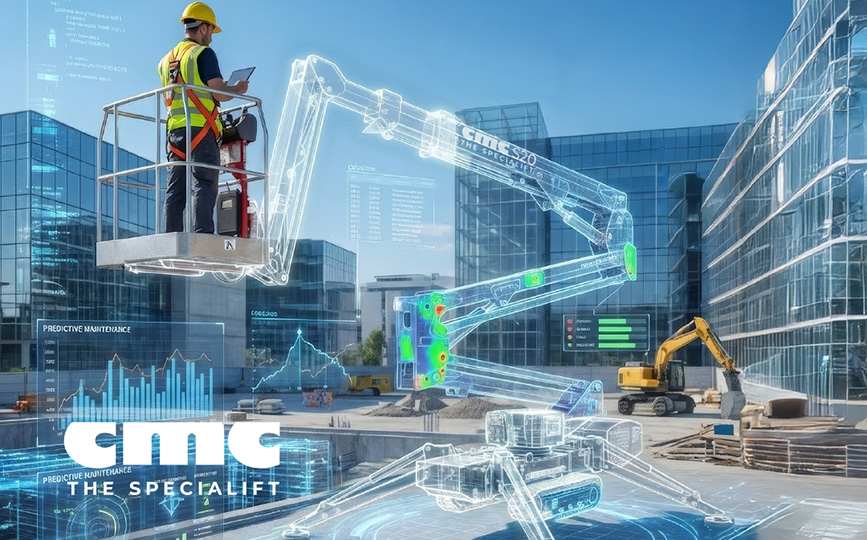
Digital Twin applied to spider lifts: from design to predictive maintenance
In recent years, the concept of the Digital Twin has emerged as one of the pillars of the fourth industrial revolution. It is a dynamic digital model, updated in real time, capable of representing not only the geometry of a product, but also its behavior, operational state, and evolution over time. In the sector of spider lifts, where structural complexity combines with often extreme operating scenarios, the Digital Twin opens up entirely new possibilities: designing with greater accuracy, virtually testing critical conditions, optimizing maintenance, and increasing safety. The ability to merge the physical and digital worlds is transforming platforms from simple lifting machines into intelligent systems endowed with memory, awareness of their own condition, and predictive capabilities.
THE DIGITAL TWIN AS AN EXTENSION OF THE DESIGN PROCESS
Traditionally, the design of spider lifts is based on three-dimensional CAD models and FEM analyses, capable of simulating loads, deflections, and stresses. While these tools remain fundamental, the Digital Twin makes it possible to go further. In the digital twin, the model is not static but connected to real data and can evolve together with the physical machine. This allows designers to experiment with lighter boom configurations, more efficient kinematics, and optimized hydraulic systems, knowing that every modification can be virtually tested across thousands of operating scenarios, many of which are difficult to reproduce in a laboratory. Simulation is no longer an isolated phase of the project, but a continuous environment that accompanies the product from conception through development.
For example, in the early stages it is possible to simulate complete work cycles, assess the impact of dynamic loads caused by ground irregularities, analyze potential wear phenomena, and optimize sensor placement. Environmental conditions such as wind, temperature, and ground inclination can be introduced into the model to verify design robustness. This makes it possible to reduce the number of physical prototypes, shorten development times, and obtain a more reliable platform from the very beginning.
FROM VIRTUAL PROTOTYPING TO ADVANCED TESTING
Virtual prototyping through the Digital Twin enables true digital stress tests. The behavior of a spider lift can be analyzed by simulating boom movements in all possible configurations, predicting structural limits, and verifying the consistency of stability curves. The dynamic models of the digital twin make it possible to introduce complex phenomena such as progressive material deformation, play in kinematic systems, hydraulic system response, and interactions among the various machine subsystems.
The more accurate the virtual model becomes, the more physical testing can focus on final verifications, reducing time and costs. In some cases, data collected from prototypes further improve the Digital Twin, feeding an iterative process that continuously increases model accuracy. The goal is a digital twin capable of faithfully replicating every behavior of the real machine, allowing technicians to anticipate potential anomalies already during the testing phase.
OPERATIONAL DIGITAL TWIN: THE ROLE OF IoT IN SPIDER LIFTS
A platform equipped with IoT sensors becomes the primary data source for updating the Digital Twin. The collection and processing of information such as vibrations, hydraulic pressures, temperatures, usage cycles, inclinations, and loads on the boom make it possible to keep the model continuously up to date. In this way, the platform is no longer a static machine, but a living system that communicates its condition and allows technicians to understand its evolution.
Integration with cloud technologies and advanced algorithms enables real-time processing. The collected data can be compared with the simulations of the digital twin, identifying deviations that may indicate the onset of a mechanical or hydraulic issue. This process paves the way for predictive functions, allowing maintenance interventions to be scheduled only when truly necessary and before a failure occurs.
PREDICTIVE MAINTENANCE AS A NEW OPERATIONAL STANDARD
Early recognition of anomalies represents one of the greatest advantages of applying the Digital Twin to spider lifts. While traditional maintenance is based on fixed time intervals, predictive maintenance leverages real data to identify the optimal moment for intervention. An example could be changes in vibrations within the articulated system, which may indicate wear of a pin or a loss of efficiency in a hydraulic cylinder. Through the digital twin, these variations are compared with the ideal model and analyzed to determine how much time remains before the component reaches a critical threshold.
For the end user, this means less downtime, more predictable maintenance costs, and greater operational safety. For the manufacturer, it means creating a continuous relationship with both the machine and the customer, delivering advanced services based on data analysis. This new digital ecosystem makes it possible to transform maintenance from reactive to proactive.
SIMULATIONS FOR TRAINING AND SAFETY
The Digital Twin can also be used as a training tool. It makes it possible to recreate complex or dangerous operating scenarios in a completely safe environment. Operators can carry out virtual training sessions, learning how to respond to critical situations such as loss of stability or unfavorable environmental conditions. The ability to integrate augmented reality allows the digital model to be overlaid onto the physical machine, providing operators with immediate information about the platform’s condition while they work.
THE FUTURE OF DESIGN: INTELLIGENT AND ADAPTIVE PLATFORMS
In the near future, the Digital Twin will not only be a monitoring tool, but a structural component of the platform itself. Machines will be able to adapt their operating parameters based on detected conditions, automatically optimizing configurations, limits, and performance. Collaboration between artificial intelligence and the Digital Twin will make it possible to predict and manage complex events, such as optimizing stability during rapid movements or identifying the best positioning of the platform in challenging environments.
The Digital Twin represents a paradigm shift for the spider lift sector. The ability to accompany the entire life of the machine—from design to maintenance—makes it possible to improve performance, reduce costs, and increase safety. The future of platforms is digital, predictive, and interconnected, and the Digital Twin is its beating heart.