

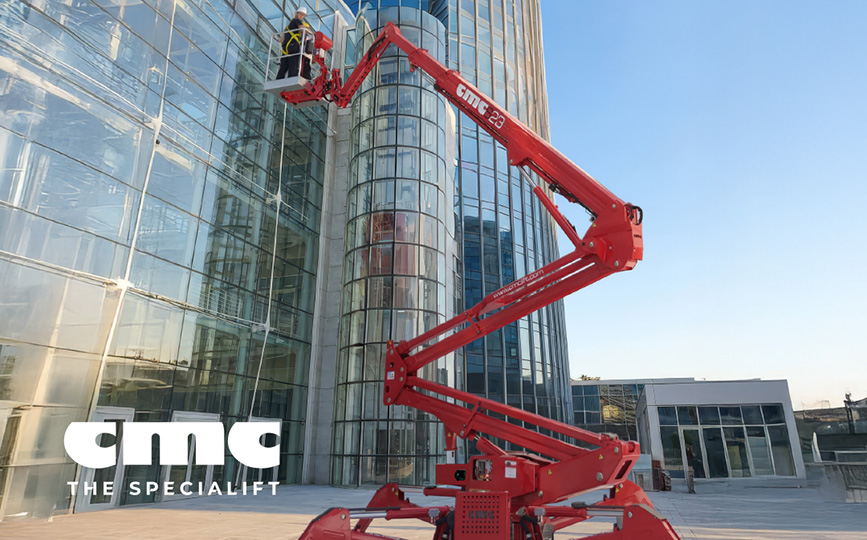
Boom geometries: optimization between stability, rigidity, and weight
Boom geometry represents the design core of every aerial platform. It is the component that determines lifting capacity, maximum reachable height, movement precision, and overall operational safety. Achieving a balance between stability, rigidity, and weight is a challenge that involves structural engineering, materials science, dynamic analysis, and the ability to anticipate extreme operating scenarios. Spider platforms add further complexity, as they must combine large boom extension with compactness, lightness, and the ability to operate on uneven terrain. The search for the ideal geometry is therefore an exercise in balance among often conflicting requirements, where every design choice has direct consequences on final performance.
Stability: the foundation of operational safety
Stability is the primary requirement in the design of an aerial platform. Every movement of the boom generates forces and moments that must be counterbalanced to prevent tipping. Boom geometries, with their joints and lengths, directly influence these phenomena. A longer boom allows greater reach, but significantly increases bending moments and sensitivity to wind. For this reason, design must consider not only static conditions, but above all dynamic ones, which are more difficult to predict.
For spider platforms, which often operate in confined spaces and on uneven surfaces, stability is even more critical. The opening of the stabilizers, weight distribution, and frame geometry work in synergy with the boom shape to ensure a balanced setup. Designers use advanced simulations that make it possible to predict the machine’s response to rapid movements, uneven loads, and variable environmental conditions. The ideal result is a boom capable of achieving large extensions without compromising the integrity of the platform.
Rigidity: precision and control
Structural rigidity is another fundamental parameter. A boom that is too flexible generates oscillations that compromise precision and safety, especially when working at great heights. Rigidity affects the operator’s perception, who must be able to rely on the stability of the basket to carry out delicate tasks such as inspections or technical installations.
To increase rigidity, designers must consider material selection, cross-section shape, and joint arrangement. FEM analyses make it possible to identify the most highly stressed areas and optimize geometry without excessively increasing weight. Over the years, the introduction of high-strength steels and advanced welding processes has made it possible to produce stiffer booms while keeping dimensions compact.
Rigidity does not concern only the main structure, but also connecting elements such as pins, bearings, and hydraulic cylinders. The quality of mechanical tolerances and wear over time can alter the dynamic characteristics of the boom. For this reason, design must consider both initial rigidity and the rigidity that must be maintained throughout the entire life cycle of the platform.
Weight: a key variable for performance and consumption
Reducing the weight of the boom is a priority for several reasons. A lighter structure consumes less energy during movement, increases the portability of the platform, and reduces the load on the stabilizers. However, lightening without losing rigidity or stability is one of the most complex aspects of design.
The development of innovative materials, such as micro-alloyed steels, structural aluminum, or advanced composites, has expanded design possibilities. Weight optimization does not simply mean reducing wall thickness, but completely rethinking geometry. Variable sections, hexagonal shapes, or optimized telescopic structures make it possible to achieve a better mass-to-strength ratio. Digital simulations help identify points where mass can be reduced without introducing critical issues.
For spider platforms, the issue of weight is even more important, as they must be transportable over sensitive terrain and, in many cases, handled manually. A lightweight boom increases the versatility of the platform and makes positioning easier.
The balance among the three factors: a multi-objective optimization problem
Stability, rigidity, and weight are not independent variables. Improving one parameter often means penalizing another. A stiffer boom may be heavier, while a lightweight boom may be less stable at large extensions. Modern design uses multi-objective optimization methods that make it possible to balance these requirements simultaneously.
In these analyses, thousands of possible configurations are simulated by modifying sections, angles, lengths, and materials. The algorithm identifies solutions that offer the best possible compromise, reducing margins of error and increasing overall process efficiency. The result is a boom that does not represent a perfect point in a single parameter, but a functional balance that maximizes operational performance.
The evolution of kinematics
Beyond cross-section shape, boom kinematics play a decisive role. Articulated and telescopic booms have very different requirements and behaviors. Multiple joints offer greater maneuverability, allowing obstacles to be overcome and otherwise inaccessible points to be reached. However, introducing joints means adding mass and potential points of flexion, requiring careful design.
Telescopic booms allow more linear extensions and lower weight, but require complex sliding and synchronization systems. The choice between these solutions depends not only on the desired working height, but also on the type of application and operating environment. Increasingly, designers adopt hybrid configurations that combine the advantages of both types, offering versatility and high performance.
The role of new materials and production techniques
The ability to use innovative materials has revolutionized the very concept of boom geometry. High-strength steels allow thicknesses to be reduced without compromise, while heat treatments improve structural durability. Techniques such as laser cutting, robotic welding, and controlled bending enable a level of manufacturing precision that was unthinkable just a few years ago.
In some fields, composite materials are being tested to further reduce weight. Although not yet widely adopted in aerial platforms, they represent an interesting future evolution. The adoption of composites would make it possible to create sections with exceptional stiffness-to-weight ratios, helping to reduce consumption and increase autonomy.
Dynamic simulations and virtual testing
Modern design no longer relies exclusively on physical testing. Dynamic simulations make it possible to analyze the boom’s response under difficult operating conditions, such as abrupt movements, lateral wind, or sudden loads. Virtual testing allows weak points to be identified and geometry to be optimized before production.
Spider platforms benefit greatly from these simulations, as they often operate in irregular environments with poorly predictable variables. Digitally testing thousands of scenarios makes it possible to obtain more robust and reliable booms, reducing prototyping costs.
The optimization of boom geometries is a complex and multidisciplinary process. Stability, rigidity, and weight represent three interdependent pillars that define the quality and performance of an aerial platform. Thanks to innovations in materials, advanced production techniques, and digital simulations, it is now possible to design increasingly high-performing, lightweight, and safe booms. Spider platforms, with their unique requirements, will continue to drive research forward, making boom geometry one of the most fascinating and decisive elements of modern mechanical design.