

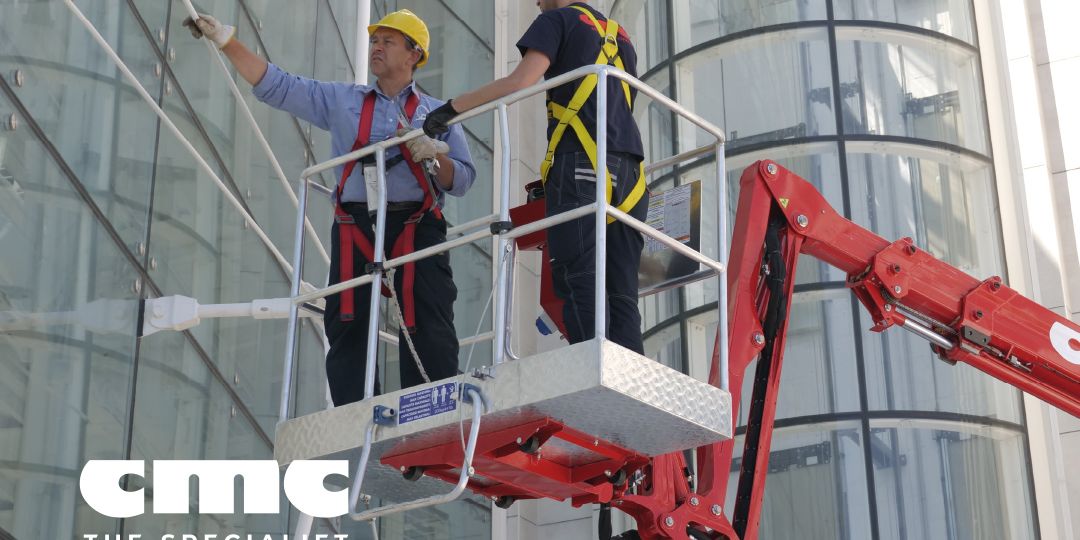
Vibration Reduction in Aerial Platforms: Engineering Solutions and Operator Safety
In the aerial platform sector, attention to operator safety and comfort is a strategic element just as important as technical performance. In this context, vibration management represents one of the most relevant and, at the same time, most complex issues to address. It is not simply about improving the user experience, but about making a tangible impact on the quality of work at height, the precision of operations, and the protection of long-term health.
Aerial platforms often operate under difficult conditions, on uneven terrain, in complex urban environments, or in natural settings where stability is never guaranteed. In these situations, vibrations become a factor that must be taken into account, and their management distinguishes machines designed to advanced standards from those that merely meet minimum requirements.
When Vibration Becomes a Critical Factor
Unlike other types of machinery, in aerial platforms vibrations are not limited to the travel phase but also occur during work at height. This aspect amplifies the problem, as the operator is positioned at an elevated level, often engaged in precision tasks where every micro-movement can make a difference.
Oscillations can arise from multiple factors. The movement of the undercarriage on uneven surfaces is one of the main causes, but not the only one. Boom movements, load variations, the action of hydraulic systems, and the structural response of the machine also contribute to the generation of oscillations.
At height, these vibrations are perceived in an amplified way. Even minimal oscillation at the base can translate into a more noticeable movement on the platform, affecting perceived stability and the operator’s ability to work safely. This impact is particularly critical in applications such as pruning, façade maintenance, or infrastructure work, where high precision is required.
Operator Safety and Impact on Performance
The presence of uncontrolled vibrations directly affects safety. An operator exposed to continuous vibrations tends to fatigue more quickly, reducing their ability to concentrate. Over time, this can lead to an increased risk of error, especially during the most delicate phases of work.
However, the issue is not limited to the margin of error. Vibrations also affect the quality of work. An unstable platform makes precision operations more difficult, increasing intervention times and reducing overall efficiency. In an increasingly competitive market, these aspects can make the difference between a job carried out quickly and accurately and one that requires continuous adjustments, with a consequent impact on execution times.
Structural Design and Oscillation Control
Reducing vibrations in aerial platforms begins with structural design. The overall geometry, weight distribution, and boom configuration are key elements for the machine’s dynamic behavior.
A well-designed structure is able to absorb and dissipate stresses, preventing them from turning into oscillations perceptible at height. This requires careful analysis of the machine’s natural frequencies and the adoption of solutions that prevent resonance phenomena.
In the case of compact tracked aerial platforms, such as those used in facility management or landscaping, the challenge is even more complex. Reduced dimensions impose compromises between lightness and rigidity, making the use of high-performance materials and advanced construction techniques essential.
The configuration of the stabilization system also plays a key role. Stabilizers designed to adapt to the terrain and ensure uniform support—even on slopes—help reduce oscillations, improving the overall stability of the machine.
The Role of Hydraulic Systems and Proportional Controls
One of the most critical elements in the generation of vibrations is the hydraulic system. Sudden or uncontrolled movements can generate stresses that propagate throughout the structure, amplifying at height.
For this reason, the most advanced aerial platforms adopt proportional control systems that allow movements to be modulated with precision. The operator can thus manage acceleration and deceleration smoothly, avoiding sudden jerks that generate vibrations.
The integration of advanced electronic components also makes it possible to synchronize movements, ensuring a uniform machine response. This translates into greater stability and more intuitive control, with clear benefits in terms of both safety and productivity.
Powertrains and Transmission: An Often Overlooked Factor
Another fundamental aspect concerns the choice of powertrain and transmission system. Internal combustion engines, especially in heavy-duty applications, can generate significant vibrations that are transmitted to the machine structure.
In recent years, the introduction of electric powertrains has represented an important step forward. Electric motors offer smoother operation, with torque available immediately and without the fluctuations typical of traditional engines. This helps reduce vibrations, improving operator comfort.
Advanced transmission systems, designed to ensure uniform traction on difficult terrain, also play an important role. A machine that moves smoothly generates fewer stresses and, consequently, fewer vibrations.
Isolation and Operator Interface
In addition to reducing vibrations at the source, it is essential to act on the interface between the machine and the operator. The most advanced aerial platforms integrate isolation systems that limit the transmission of vibrations to the basket.
The use of elastic mounts and anti-vibration materials makes it possible to create a sort of barrier between the structure and the work area. This does not completely eliminate vibrations, but significantly reduces their perceived intensity.
The design of controls and contact surfaces is also crucial. Ergonomic controls, designed to absorb micro-oscillations, help improve control and reduce fatigue.
Innovation and Future Outlook
The future of aerial platforms also depends on increasingly intelligent vibration management. The integration of sensors and monitoring systems opens the way to solutions capable of adapting in real time to operating conditions.
In this scenario, companies that invest in research and development position themselves as key players in an evolution that goes beyond simple technological innovation. It is a cultural shift that places the operator at the center and recognizes the value of work quality.
Vibration reduction in aerial platforms is no longer an accessory element, but a determining factor for competitiveness. Machines that ensure greater stability, comfort, and precision offer a tangible advantage to operators and the companies that use them.
Investing in advanced engineering solutions means not only complying with regulations, but also improving work quality, reducing risks, and increasing efficiency. In a market increasingly oriented toward safety and sustainability, these aspects represent a fundamental differentiating factor.
For those operating in the sector, choosing an aerial platform can no longer be based exclusively on traditional parameters such as working height or load capacity. The ability to manage vibrations and ensure a stable and safe working environment becomes an essential evaluation criterion.
This is where engineering meets industrial vision, transforming a technical challenge into a concrete opportunity for growth and innovation.