

Advanced electrical insulation for work near powerlines
In the MEWP sector, working in proximity to high-voltage power lines represents one of the most critical and complex operating conditions. Data from safety reports published by IPAF highlight how electrocution is among the leading causes of serious and fatal accidents involving mobile elevating work platforms, often due to direct or indirect contact with live lines. In these contexts, safety is not just a priority but an essential requirement that guides every design decision. Advanced electrical insulation therefore becomes a key element, capable of determining not only operator protection but also the overall reliability of the machine, playing a decisive role in preventing high-risk events.
In recent years, technological evolution has led to a significant shift in how aerial platforms address this type of application. It is no longer simply a matter of adding insulating components, but of designing integrated systems in which every element contributes to creating an effective barrier against electrical risk. In this scenario, engineering plays a decisive role, transforming a regulatory requirement into a truly differentiating factor.
Electrical risk in work at height
Activities near high-voltage lines expose operators to risks that go far beyond direct contact. The phenomenon of electrical arcing, for example, can occur even at a distance, creating extremely dangerous situations. This is compounded by the possibility of leakage currents which, in the absence of adequate insulation systems, may travel through the structure of the machine.
In aerial platforms, the risk is amplified by the elevated position of the operator and the need to work with precision in often confined spaces. Even a slight distraction or uncontrolled movement can bring the machine close to a critical zone, making the presence of reliable protection systems essential.
For this reason, the concept of electrical insulation cannot be considered a simple technical requirement. It is a structural component of the design, which must ensure consistent performance over time, even in challenging environmental conditions such as humidity, dust, or extreme temperatures.
Regulations and reference standards
The regulatory framework governing the use of aerial platforms near power lines is particularly stringent. At the European level, the Machinery Directive 2006/42/EC establishes the essential health and safety requirements for the design and construction of work equipment, while the EN 280 standard defines specific criteria for mobile elevating work platforms, including safety requirements for use near electrical lines. At the international level, the ISO 16368 standard provides additional guidance on design, structural calculations, and safety levels. Furthermore, with regard to electrical risk, standards such as IEC 61057 and IEC 61478 help define insulation requirements and testing methods for equipment used in high-voltage environments. European directives and international standards therefore set precise requirements in terms of insulation, testing, and certification, ensuring high levels of operational safety.
Machines intended for this type of application must be designed and built to guarantee a specific level of insulation, expressed in nominal voltage. This involves not only the selection of suitable materials, but also the adoption of highly rigorous manufacturing processes and quality controls.
Regulatory compliance represents the starting point, but the most advanced companies go further by developing solutions that exceed minimum standards and offer an additional safety margin. In a sector where error is not allowed, this approach makes the difference.
Insulating materials and structural design
One of the key aspects of advanced electrical insulation concerns material selection. Aerial platforms designed to operate near high voltage use components made from high-performance composite materials capable of ensuring both high electrical and mechanical resistance.
These materials must retain their properties even under varying environmental conditions, avoiding degradation phenomena that could compromise insulation. Resistance to humidity, UV radiation, and chemical agents therefore becomes an essential requirement.
Structural design plays an equally important role. Insulated parts must be integrated into the machine in such a way as to create a continuous protective path between the operator and the ground. This means eliminating any possible electrical contact point and ensuring effective separation between conductive and insulated zones.
In aerial platforms, the boom is one of the most critical elements. The adoption of insulated sections, designed to interrupt electrical continuity, helps reduce the risk of current transmission toward the platform basket.
Insulation architectures and system redundancy
Advanced electrical insulation is not based on a single component, but on a complex architecture involving multiple levels of protection. This redundant approach is essential to ensure safety even in the event of failure or deterioration of one of the elements.
The most advanced aerial platforms integrate systems that combine structural insulation, active protections, and monitoring devices. The goal is to create a safety network in which each element contributes to reducing overall risk.
For example, in addition to insulating materials, systems may be present that automatically limit machine movements when approaching a hazardous area. These solutions, based on sensors and electronic controls, represent an additional layer of protection alongside passive insulation.
Another important aspect concerns the management of leakage currents. Systems designed to detect anomalies and interrupt machine operation help prevent critical situations, increasing overall safety.
Maintenance and long-term reliability
An electrical insulation system is only effective if it maintains its characteristics over time. For this reason, maintenance plays a central role in managing aerial platforms intended for work near high voltage.
Periodic inspections must verify the integrity of insulating materials, the absence of contamination, and the correct functioning of protection systems. Even small defects, such as cracks or dirt accumulation, can reduce insulation effectiveness and increase risk.
The most structured companies adopt rigorous maintenance protocols, supported by advanced diagnostic tools. This approach makes it possible to identify potential issues before they become problems, ensuring a consistent level of safety.
Operator training is also essential. Understanding the machine’s characteristics and correct usage methods helps reduce the risk of improper use that could compromise insulation.
Innovation and emerging technologies
Innovation in the field of electrical insulation is opening new perspectives for the aerial platform sector. The introduction of increasingly high-performance materials, combined with the development of intelligent control systems, is making it possible to achieve safety levels that were unthinkable just a few years ago.
Among the most interesting trends is the integration of continuous monitoring systems capable of assessing insulation status in real time. These technologies allow for prompt intervention in the event of anomalies, reducing the risk of sudden failures.
Digitalization is also playing an increasingly important role. Next-generation aerial platforms can be integrated into management systems that collect and analyze operational data, providing useful insights to improve safety and efficiency.
This data-driven approach represents a paradigm shift, where prevention becomes a key element in managing electrical risk.
A strategic value for the market
Advanced electrical insulation is not only a response to regulatory requirements, but also a true value driver for the market. Companies operating in sectors such as power grid maintenance, energy, or infrastructure seek solutions that ensure maximum safety without compromising productivity.
In this context, aerial platforms designed with advanced insulation systems represent a strategic investment. They enable operations in complex conditions with greater confidence, reducing intervention times and increasing efficiency.
For manufacturers, this translates into an opportunity to differentiate themselves by offering solutions that combine innovation, reliability, and attention to the operator. It is not just about selling a machine, but about providing a concrete response to increasingly specific operational needs.
The CMC i Series: isolation engineering in practice
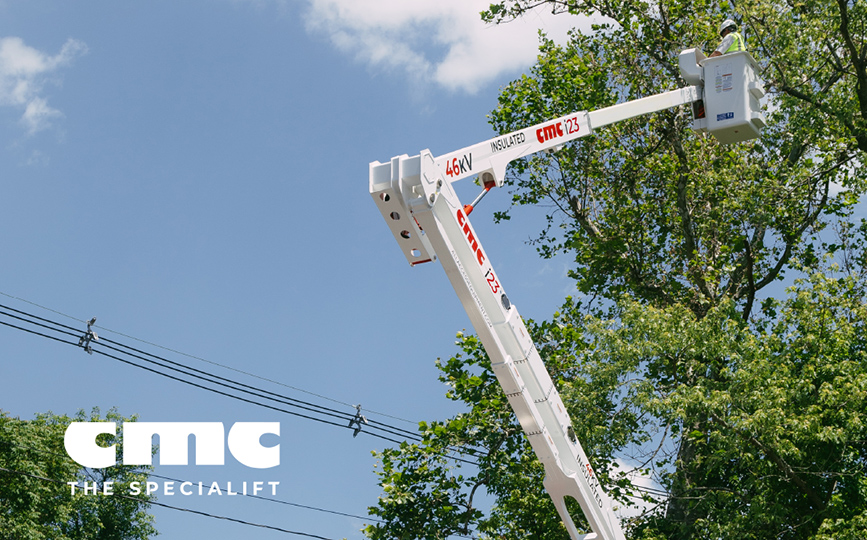
Against this backdrop, CMC has developed a concrete response with its own i Series, embodied in the i23 and i27 models, insulated aerial platforms designed specifically to operate in proximity to high-voltage power lines and insulated up to 46 kV. These are not retrofitted adaptations of standard machines, but designs developed from the ground up with electrical isolation as the primary engineering constraint, not as a requirement to be addressed as an afterthought.
The i23 and i27 deliver an isolation level of up to 1,000 V AC and 1,500 V DC, with an insulation class certified to IEC 61057 and IEC 61478 standards, covering the most demanding applications in the energy and infrastructure sectors. The boom integrates sections made from high-dielectric-strength composite material, engineered to break the electrical continuity between the basket and the chassis, dramatically reducing the risk of current paths through the structure. Every component in the isolation path (from hydraulic joints to control connections) has been redesigned to eliminate the potential short-circuit points commonly found in hybrid solutions.
From a safety architecture standpoint, both platforms take a redundant approach: passive structural isolation is complemented by an active dielectric resistance monitoring system, capable of detecting any degradation in real time and signalling anomalies before they translate into hazardous conditions. This continuous supervision system is one of the most distinctive features of the i Series compared to conventional solutions.
In operational terms, the i27 (with its greater working height) addresses contexts such as transmission line and substation maintenance, where distance from live conductors must be managed with millimetre precision. The i23, more compact and manoeuvrable, finds its optimal application in urban distribution networks and more constrained environments, where the combination of agility and protection becomes decisive.
Both models are certified to EN 280 and comply with the requirements of Machinery Directive 2006/42/EC, but CMC’s design choices went beyond mere conformity: the composite materials used in the insulated sections were selected to maintain their dielectric properties even in the presence of moisture, conductive dust, and significant thermal variation (conditions far from uncommon on real job sites). The testing protocol includes a dielectric withstand test on every individual machine prior to delivery, with traceable documentation accompanying the platform throughout its entire lifecycle.
The CMC i Series demonstrates that advanced electrical isolation can be integrated into a machine that sacrifices nothing in terms of productivity: load capacity, working angles, and positioning speed remain competitive with non-insulated counterparts, giving operators a tool that does not force a choice between safety and efficiency. It is this synthesis, not mere standards compliance, that represents the true value of the i Series in the market for aerial platforms operating in electrically critical environments.
Safety as a driver of innovation
When working near high voltage, safety cannot be left to chance. Advanced electrical insulation represents one of the most important frontiers of engineering applied to aerial platforms, where technology and responsibility meet.
Investing in advanced solutions means protecting operators, improving work quality, and strengthening competitiveness. In an ever-evolving market, the ability to guarantee high safety standards becomes a distinguishing factor that truly makes a difference.
The aerial platforms of the future will be increasingly safe, intelligent, and integrated, but the core principle will remain the same: putting the operator at the center, providing tools that enable efficient work and, above all, complete safety.