

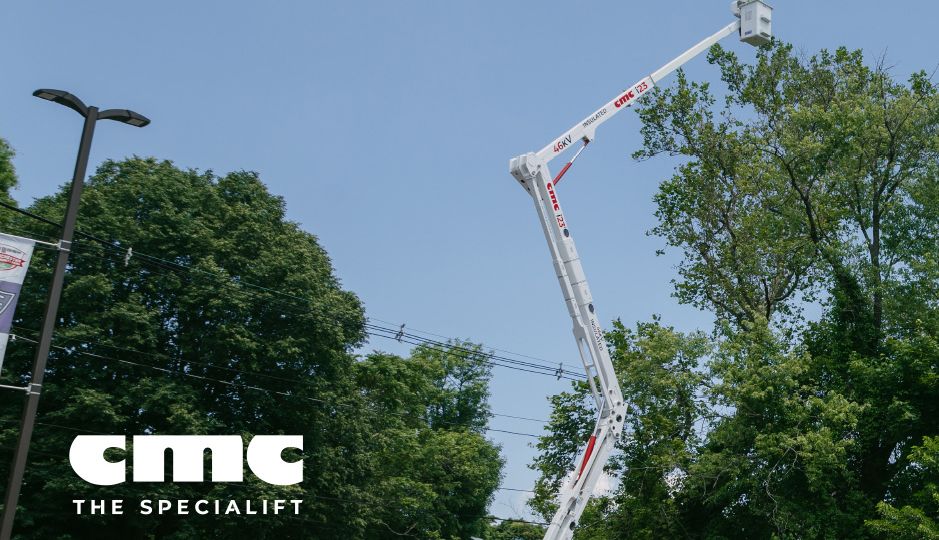
Advanced composites materials for lighter, stronger platforms
In the world of working at height, the concept of elevation has never been just a vertical matter. It has always been a complex balance between weight, strength, safety, and performance. Today, that balance is changing radically thanks to the introduction of advanced materials such as composites. This is not a technological trend, but a structural response to the new demands of industry: lighter, higher-performing, and more reliable machines operating in increasingly complex environments.
Beyond Steel: Why Materials Matter More Than Ever
For decades, steel has been the backbone of lifting platforms. Strong, predictable, and relatively economical, it has ensured safety and durability. However, the evolution of working at height—especially in industrial and infrastructural contexts—has introduced new constraints. Tight spaces, sensitive flooring, rapid transport requirements, and ever-stricter load limits have made it clear that robustness alone is no longer enough.
In this scenario, advanced materials emerge as both a technical and strategic solution. Reducing weight without compromising strength means expanding the operational range of platforms, improving stability, and increasing overall safety. It is a quiet transformation that starts at the structural level and reflects across the entire value chain.
What Composite Materials Are and Why They Make a Difference
Composite materials are created by combining two or more components with different properties, designed to work together synergistically. In lifting platforms, this often translates into high-strength fibers integrated into polymer matrices, offering a strength-to-weight ratio far superior to that of traditional metals.
The advantage is not merely numerical. Composites allow for greater design freedom, enabling structures to be shaped according to actual stress conditions. Where rigidity is needed, the structure provides it. Where controlled flexibility is required, the material responds without permanent deformation. This engineering approach reduces unnecessary mass and optimizes the machine’s dynamic behavior.
Structural Performance and Operational Safety
In working at height, safety is always a structural issue before it becomes a procedural one. A lighter platform is not automatically safer, but a platform designed with advanced materials can be. The key lies in controlling deformation and maintaining consistent performance over time.
Composites offer high resistance to corrosion—crucial in aggressive industrial environments or outdoor applications. Their fatigue resistance also allows them to withstand intensive work cycles without performance loss. This translates into greater long-term reliability and reduced risks associated with structural wear.
The introduction of advanced materials is not a simple upgrade of existing components; it requires a complete rethinking of design. Modern platforms are no longer assemblies of standard parts, but integrated systems in which every element contributes to overall balance.
Thanks to composites, booms, telescopic sections, and structural components can be redesigned with optimized geometries. This approach lowers the machine’s center of gravity, improves stability, and expands operational configurations. For work at height, it means reaching previously inaccessible points with greater precision and safety.
Energy Efficiency and Sustainability
Weight reduction also has a direct impact on energy efficiency. Lighter platforms require less energy to move, reducing consumption and emissions—especially in electric and hybrid versions. In an industrial context increasingly focused on sustainability, this aspect takes on strategic value.
Composite materials also enable longer service life and reduced maintenance requirements. Fewer replacements, less downtime, and a longer lifecycle help reduce the machine’s overall environmental impact. In this case, sustainability is not a compromise, but a direct result of technological innovation.
New Challenges, New Skills
The adoption of composites also brings new challenges. Production processes are more complex, requiring specialized skills and advanced quality controls. Working with these materials leaves no room for improvisation: every phase, from design to manufacturing, must be managed with absolute precision.
For platform manufacturers, this means investing in know-how, research, and infrastructure. But it also means differentiating themselves in the market by offering solutions that go beyond mere regulatory compliance. Material quality becomes an integral part of the value proposition.
Putting the Operator Experience at the Center
One of the less obvious—but most significant—effects of using advanced materials concerns the operator’s experience. A lighter, stiffer platform responds better to controls, reduces oscillations, and conveys a greater sense of control. In work at height, this perception is crucial.
Reduced vibrations and greater movement precision help lower fatigue, improving concentration and safety. It is a clear example of how material choices can have a direct impact on the human factor, often underestimated in purely technical analyses.
Looking Ahead
Advanced materials do not represent a final destination, but a starting point. Research continues to develop new fibers, new matrices, and new production techniques, with the aim of further improving performance and sustainability. In working at height, this evolution is set to continue, alongside integration with automation and artificial intelligence.
For companies like CMC, innovation in materials is part of a broader vision that approaches the future of the sector systemically. It is not just about building lighter machines, but about redefining what it means to work at height in the 21st century.
A New Standard for Working at Height
The introduction of composites is gradually defining a new standard. Lighter, stronger, and smarter platforms are no longer the exception, but a clear direction. In a sector where every detail matters, materials become a strategic element, capable of making the difference between a conventional solution and a truly innovative one.
The future of working at height also passes through this choice: the ability to select, design, and integrate materials that respond to today’s challenges and anticipate those of tomorrow. A future where lightness is not fragility, but control, precision, and safety taken to new heights.