

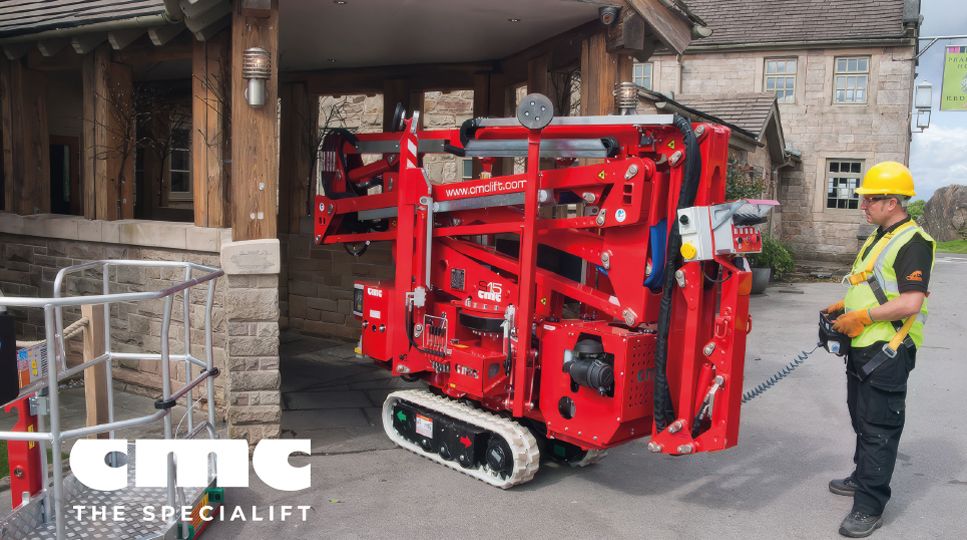
Ultra-Compact Platforms: Extreme Design for difficult Access
In the aerial platform industry, the concept of compactness is no longer enough to describe the ongoing evolution. Today, the market demands increasingly extreme solutions capable of operating in spaces that, until a few years ago, were simply inaccessible. This is where ultra-compact aerial platforms come into play, machines designed to overcome physical, logistical and operational limits without sacrificing performance, safety or reliability.
This segment represents one of the most complex and stimulating engineering challenges. Reducing size and weight while maintaining high standards of stability and operational capacity requires a complete rethinking of how an aerial platform is designed. It is not a matter of simple miniaturization, but of true extreme engineering, where every component is optimized to deliver maximum performance within minimal space.
When space becomes the primary constraint
The applications of ultra-compact aerial platforms stem from very concrete needs. Historic city centers, congested industrial environments, indoor spaces, complex gardens and operations between existing structures are all contexts where available space is limited and traditional solutions cannot be used.
In these scenarios, access becomes the first obstacle. Narrow passages, doorways, corridors, level changes and delicate surfaces require machines capable of adapting without compromising safety. The platform must be easy to transport, precise to position and fully operational even in seemingly prohibitive conditions.
But compactness is not only about dimensions. It is about mobility, maneuverability and adaptability. An ultra-compact machine must move with agility, handle complex paths and position itself exactly where needed, often with minimal margin for error.
Engineering reduction: designing without compromise
Reducing the size of an aerial platform while maintaining high performance requires a radical design approach. Every element must be analyzed, optimized and intelligently integrated.
The structure is the starting point. The use of high-strength steels and advanced materials allows thicknesses to be reduced without compromising rigidity. This makes it possible to contain overall weight while improving stability and load capacity.
Weight distribution becomes a critical factor. In a compact machine, even small variations can influence dynamic behavior. Engineers work to achieve perfect balance, where the center of gravity contributes to stability even in complex operating conditions.
The result is a machine that, despite its reduced dimensions, delivers performance comparable to larger platforms while maintaining a high level of safety.
High-precision components and control systems that allow for progressive, controlled movements
One of the most fascinating aspects of ultra-compact aerial platforms is the design of the boom. In limited spaces, the ability to reach difficult areas depends on the precision and flexibility of movement.
The most advanced solutions adopt articulated and telescopic kinematics that allow operators to overcome obstacles, work below ground level and access otherwise unreachable areas. Designing these systems requires a delicate balance between compactness, strength and smooth movement.
Each joint must be engineered to ensure maximum outreach within minimal space. This involves high-precision components and control systems that enable progressive and controlled movements.
The real challenge is maintaining stability throughout all operating phases. Even with the boom fully extended, the machine must ensure safety and precision without oscillations or loss of control.
Transportability and ease of access
Another key feature of ultra-compact aerial platforms is their ability to be transported and positioned easily. In many cases, these machines are used in urban or residential environments where access with heavy vehicles is limited.
The possibility of towing them, loading them onto small vehicles or even handling them manually represents a significant competitive advantage. This allows for reduced intervention times and more flexible operations.
Weight plays a fundamental role. A lightweight machine can be used on sensitive surfaces such as historic pavements or landscaped areas without causing damage. At the same time, it must ensure the robustness required for safe operation.
Design therefore focuses on solutions that combine lightness and strength, using advanced materials and technologies to achieve the best possible balance.
Stability and safety in extreme conditions
Compactness can never come at the expense of safety. On the contrary, because they operate in complex environments, ultra-compact aerial platforms must offer even higher safety standards.
Stabilization systems are designed to adapt to uneven surfaces and confined spaces. Compact outriggers, configurable in different modes, allow operators to find the best setup for each specific situation.
Control systems also play a crucial role. Sensors and electronic devices continuously monitor machine conditions, intervening in case of anomalies. This helps prevent risky situations and ensures safe use even for less experienced operators.
The combination of structural stability and electronic control is one of the defining features of next-generation platforms.
Compact power systems and sustainability
The reduction in size has also driven the evolution of power systems. Ultra-compact aerial platforms adopt increasingly efficient solutions capable of delivering high performance within limited space.
Electric powertrains are becoming more widespread. In addition to ensuring quiet, emission-free operation, they allow greater precision in movement and better energy management.
This is particularly important in indoor environments or sensitive contexts where emissions and noise are critical factors. Electric machines offer the possibility to operate sustainably without compromising performance.
Continuous innovation and new application frontiers
Ultra-compact aerial platforms are opening new operational possibilities across multiple sectors. From urban maintenance to arboriculture, from light construction to industrial interventions, these machines make it possible to tackle jobs that previously required complex solutions or manual work.
Innovation continues to push boundaries further. New materials, advanced control systems and innovative design solutions are expanding the capabilities of these machines, making them increasingly versatile.
In this context, companies that invest in research and development gain a strategic advantage. The ability to anticipate market needs and deliver innovative solutions becomes a key differentiator.
A new standard for the industry
Ultra-compact aerial platforms are no longer a niche product but an increasingly relevant part of the aerial platform market. Their adoption is set to grow, driven by the need to operate in more complex environments and by the demand for flexible solutions.
For operators, this means access to more efficient tools that reduce time and costs. For manufacturers, it represents both a challenge and an opportunity that requires advanced expertise and a strong innovation-driven vision.
Beyond access limits
The design of ultra-compact aerial platforms demonstrates how engineering can turn limitations into opportunities. Reducing size without sacrificing performance and safety is a challenge that requires expertise, creativity and innovation.
In a world where space is increasingly limited and operational needs are becoming more specific, these machines offer a concrete and advanced solution. It is not just about accessing difficult places, but about doing so efficiently, safely and sustainably.
Ultra-compact aerial platforms are defining a new industry standard, paving the way for a future where no access is truly impossible.